

Powerbroker AI · Roots · Zywave · Archipelago
The Landscape
AI is changing how commercial insurance brokers work, but not all AI tools are solving the same problem. Some automate what happens on the carrier side when a submission arrives. Some help brokers prospect and source leads. Some extract structured data from property documents to speed up renewals. And some focus on the analytical work inside policy and coverage documents: comparing quotes, identifying gaps, building proposals.
This post compares four platforms that represent distinct approaches to leveraging AI in commercial insurance: Powerbroker AI, Roots, Zywave, and Archipelago. Each is doing real, substantive AI work, they just solve different parts of the workflow.
The Platforms
Powerbroker
Powerbroker is an AI-powered document intelligence platform focused on the analytical work commercial brokers do with policy and coverage documents. Its core capabilities center on policy comparison, coverage gap analysis, proposal generation, contract review against policy language, and claim denial review. It also includes document extraction workflows for schedules and ACORD forms. It has features specifically for employee benefits. AMS and Applied Epic integration are in development. See a case study with Scott insurance here.
Roots
Roots (formerly Roots Automation) is an agentic AI platform built for insurance operations. Its InsurGPT model powers a suite of AI agents that automate the high-volume, document-intensive work on the carrier and broker operations side: submission intake and triage, loss run processing, underwriting data extraction, schedule analysis, premium audits, and claims automation. Roots is used by three of the top five U.S. P&C carriers and three of the top ten brokers.
Zywave
Zywave is a large-scale insurance technology platform serving over 150,000 insurance professionals. Its current AI agents focus on prospecting — lead sourcing, research and enrichment, and outreach automation — combined with its established benchmarking analytics and CPQ/proposal tools. Zywave has publicly stated that coverage-gap analysis, contract comparisons, and policy benchmarking are on its 2026 AI agent roadmap. It was recognized as a Leader in Insurance Agency Management Systems by Forrester Research in late 2025.
Archipelago
Archipelago is an AI platform for commercial property brokers, focused on making property and casualty data preparation fast and accurate. Its AI agents process SOVs, loss runs, payroll records, vehicle lists, and property condition assessments — extracting and enriching data from those documents for submission use. It claims to reduce account data preparation from hours or days to approximately 15 minutes. It has processed properties representing over $2.3 trillion in total insured value.
Feature Comparison
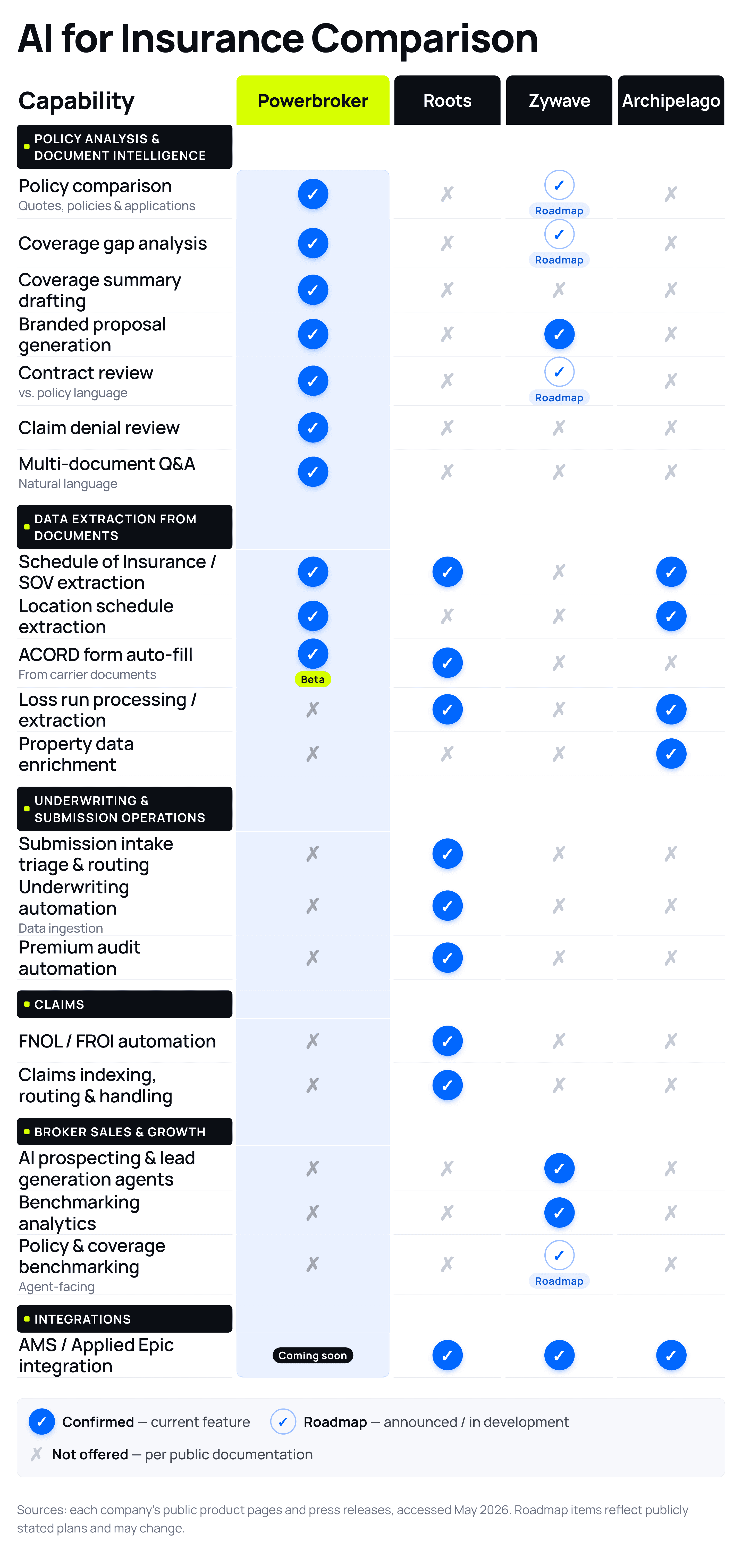
Sources: each company's public product pages and press releases, accessed May 2026. ✓ (roadmap) = publicly stated as upcoming / in development; ✗ = not an offered or announced feature per public documentation.
What the Matrix Actually Shows
These tools solve different problems, with some real overlap
If there’s one thing the matrix makes clear, it’s that these four platforms weren’t really built to compete with each other. They emerged from different pain points, served different teams, and handled different stages of the workflow. Lumping them together as “AI for insurance brokers” is true, but it doesn’t mean one can replace the other.
Where we see the most overlap
Schedule and exposure data extraction
Roots pulls structured data from SOVs, benefits schedules, vehicle lists, and property documents as part of its underwriting automation.
Archipelago does similar work for commercial property.
Powerbroker extracts Schedules of Insurance and location data.
These features are across all of the tooling besides Zywave.
A combination worth considering
For brokers thinking about day-to-day operations as a whole, the most natural pairing in this comparison is Roots and Powerbroker. Roots handles the operational throughput: getting submissions in, processing loss runs, and routing claims. Powerbroker handles the analytical work on top of that: comparing carrier quotes, identifying coverage gaps, reviewing contracts, and building proposals. They cover different parts of the workflow and don’t overlap too much. This is why we see it as a powerful combination if you’re shopping around for insurance AI tools.
About Powerbroker
Powerbroker's current workflow library includes Policy Check, Quick Comparison, Coverage Gaps, Proposal, Coverage Summary, Contract Reviews, Claim Denial Review, Ask A Question, Insurance Chat, Schedule of Insurance extraction, ACORD-125 auto-fill (beta), and Location Schedule extraction. AMS integration and Applied Epic connectivity are in active development, as is support for benefits lines.
Want to see Powerbroker's document analysis in action?
Request a demo at https://www.powerbroker.ai/book-a-call